
API 设计 / 系统课时
使用 Interface 与 Union
使用 Interface 与 Union
当一个查询入口可能返回多种对象时,关键不是“能不能混在一起”,而是这些对象是否存在稳定的共同字段。本课用可运行的 GraphQL.js 示例区分 Interface 与 Union,并演示客户端如何通过抽象类型安全地读取具体字段。
学习目标
- 根据是否存在共同字段选择 Interface 或 Union
- 为抽象类型提供可解析的具体类型信息
- 使用片段与内联片段查询不同实现类型的字段
先判断共同契约是否存在
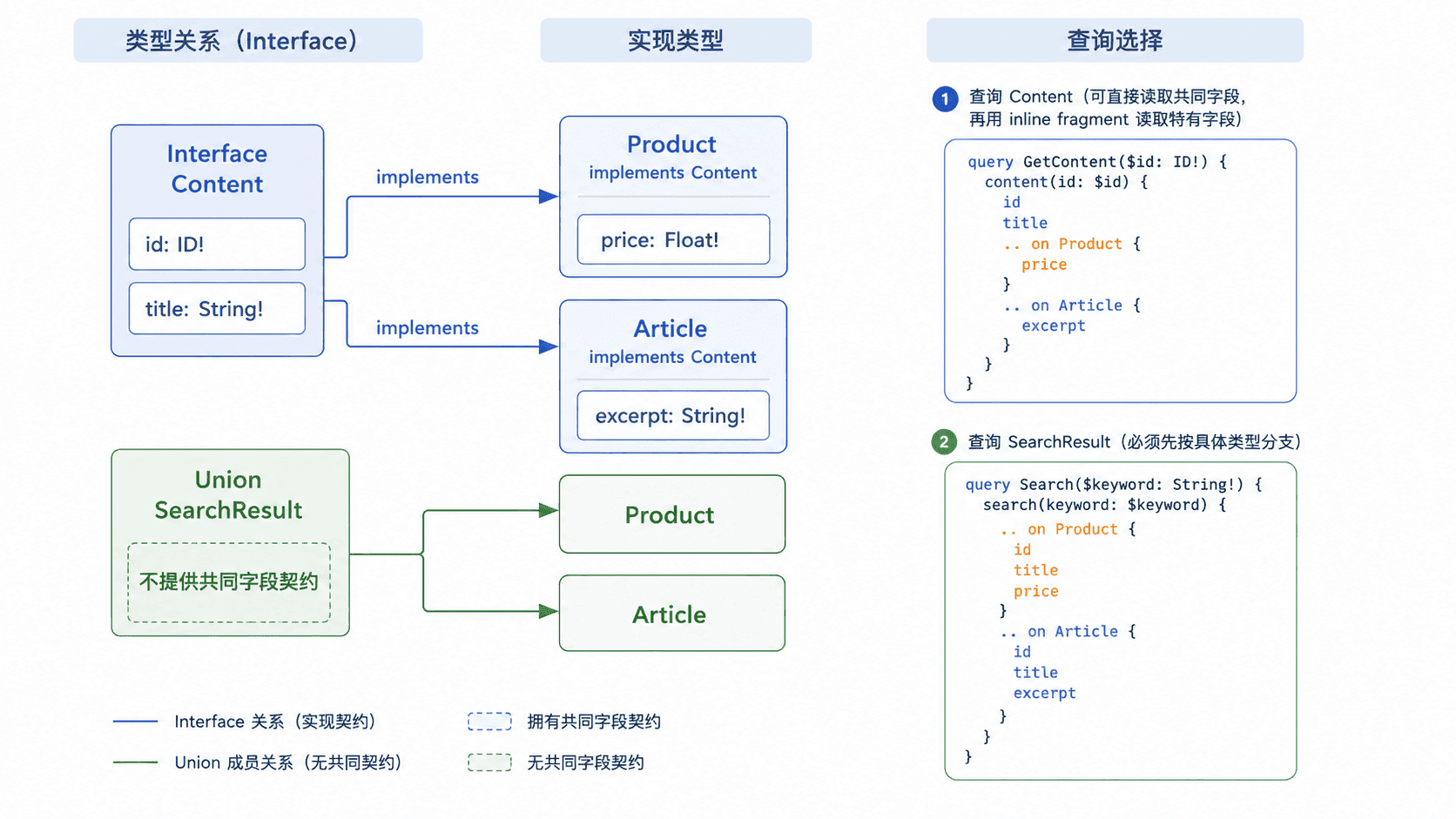
Interface 表达“这些类型都承诺提供一组共同字段”。例如文章和商品都可以视为内容,都有 id 与 title。客户端只依赖这两个字段时,不必知道实际拿到哪一种内容。
Union 只表达“结果可能是这些类型之一”,不要求成员共享字段。搜索结果同时包含文章和商品很常见,但 GraphQL 不允许直接在 Union 上选择成员字段;客户端必须先用内联片段进入具体类型。
| 需求 | Interface | Union |
|---|---|---|
| 多个类型有稳定共同字段 | 适合 | 可以,但会丢失共同契约 |
| 成员类型彼此异构 | 不适合强行抽象 | 适合 |
| 在抽象类型上直接查询共同字段 | 可以 | 不可以 |
| 成员必须显式声明关系 | implements |
由 Union 列出成员 |
用一个 Schema 同时观察两者
下面的示例使用 graphql 包。项目中需要已安装该依赖,脚本保存为 index.mjs 后即可运行。
import { buildSchema, graphql } from "graphql";

const schema = buildSchema(`
  interface Content {
    id: ID!
    title: String!
  }

  type Product implements Content {
    id: ID!
    title: String!
    price: Int!
  }

  type Article implements Content {
    id: ID!
    title: String!
    excerpt: String!
  }

  union SearchResult = Product | Article

  type Query {
    content(id: ID!): Content
    search: [SearchResult!]!
  }
`);

const items = [
  { __typename: "Product", id: "p1", title: "Keyboard", price: 499 },
  { __typename: "Article", id: "a1", title: "GraphQL Tips", excerpt: "Use fragments." }
];

const rootValue = {
  content: ({ id }) => items.find((item) => item.id === id) ?? null,
  search: () => items
};

const source = `
  query {
    content(id: "p1") {
      id
      title
      ... on Product { price }
    }
    search {
      __typename
      ... on Product { id title price }
      ... on Article { id title excerpt }
    }
  }
`;

const result = await graphql({ schema, source, rootValue });
console.log(JSON.stringify(result, null, 2));
预期输出:
{
  "data": {
    "content": {
      "id": "p1",
      "title": "Keyboard",
      "price": 499
    },
    "search": [
      {
        "__typename": "Product",
        "id": "p1",
        "title": "Keyboard",
        "price": 499
      },
      {
        "__typename": "Article",
        "id": "a1",
        "title": "GraphQL Tips",
        "excerpt": "Use fragments."
      }
    ]
  }
}
这里直接返回 __typename,GraphQL.js 的默认抽象类型解析器就能确定对象是 Product 还是 Article。在真实服务中也可以为 Interface 或 Union 提供显式的类型解析逻辑,但无论采用哪种方式,服务端都必须能把运行时对象映射到 Schema 中的具体对象类型。
客户端查询抽象类型的规则
查询 Content 时,id、title 属于 Interface 本身,因此可以直接选择;price 只属于 Product,必须放进 ... on Product 内。这个规则使共同契约保持稳定,同时允许实现类型继续扩展自己的字段。
查询 SearchResult 时,除了 __typename 这类元字段,业务字段都要放在具体类型的内联片段或命名片段中。客户端通常先读取 __typename,再根据类型渲染不同组件,这比靠某个可空字段猜类型更可靠。
选择 Interface 还是 Union
如果调用方需要围绕一组共同字段做分页、缓存、权限或通用展示,优先设计 Interface;如果查询只是在一个入口聚合若干彼此独立的结果类型,Union 更自然。两者都属于抽象类型,但 Interface 强调可依赖的共同能力,Union 强调有限的类型集合。