
C / C++ / 系统课时
用线程池分摊新连接负载
用线程池分摊新连接负载
本节在 one loop per thread 之上增加 EventLoopThreadPool:监听线程只执行 accept 和轻量连接初始化,然后按轮询策略把新连接交给多个 I/O Loop。这样既能利用多核并行处理连接,又不需要为每个连接单独创建线程。
学习目标
- 实现由多个
EventLoopThread组成的 I/O 线程池。 - 使用轮询策略把新连接稳定分配到不同
EventLoop。 - 明确 Acceptor、主 Loop 与子 Loop 之间的职责边界。
新连接应该去哪里
多 Reactor 模型中,监听 socket 通常仍绑定在主 EventLoop。主线程收到监听 fd 的可读事件后执行 accept,为新连接选择一个子 Loop;连接后续的读写事件则注册到该子 Loop,不再长期占用监听线程。
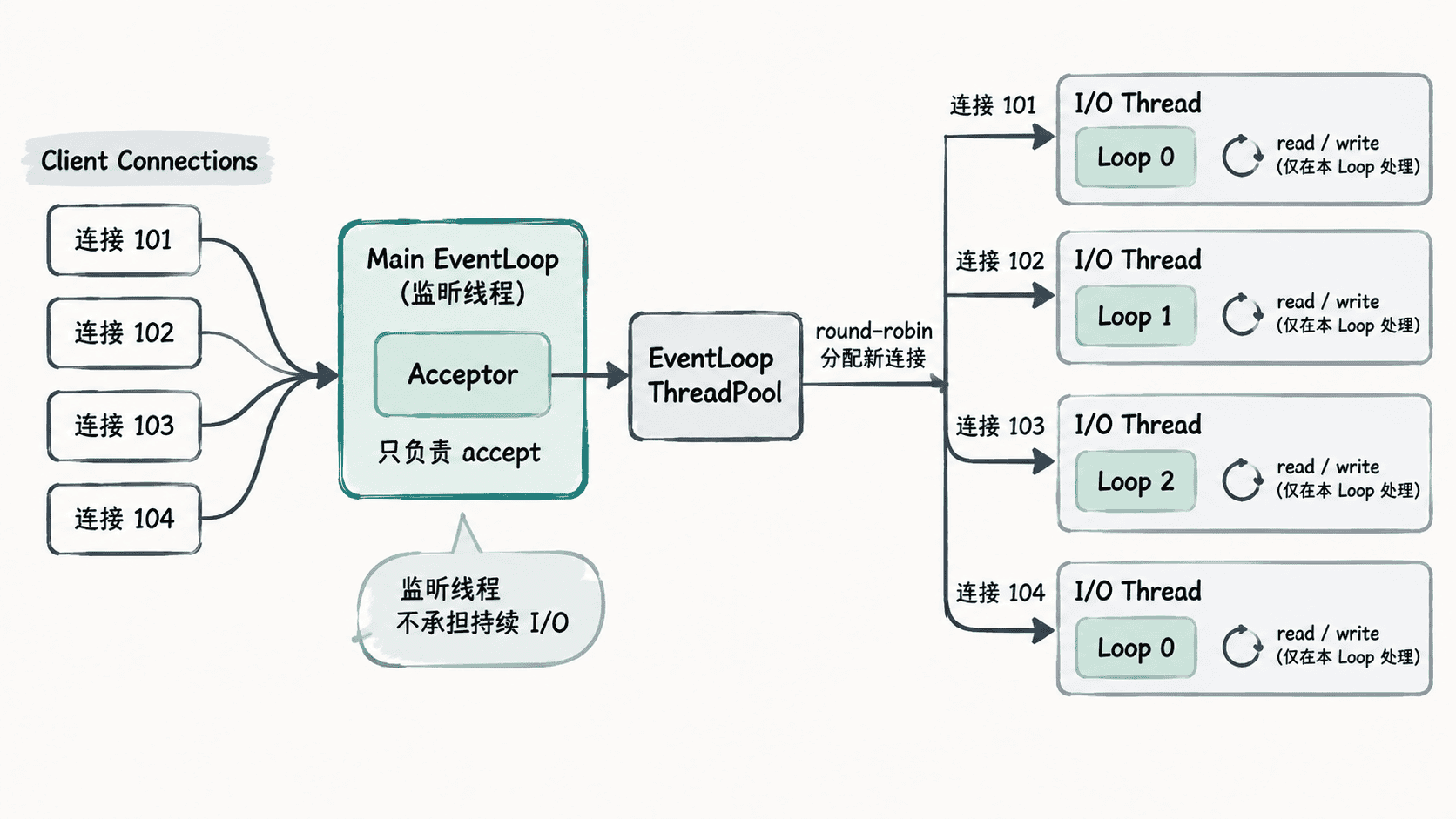
这种拆分让监听线程可以迅速回到下一次 accept,同时让不同连接在多个 CPU 核心上并行执行事件回调。线程数量并非越多越好,实际项目应结合 CPU 核数、回调耗时和上下文切换成本压测决定。
实现 EventLoopThreadPool
下面给出一个可运行的最小实现。EventLoop 只模拟线程常驻,EventLoopThreadPool 负责启动三个工作 Loop,并通过 next_ 维护下一次轮询位置。
#include <condition_variable>
#include <iostream>
#include <memory>
#include <mutex>
#include <thread>
#include <vector>

class EventLoop {
public:
    explicit EventLoop(int index) : index_(index) {}

    int index() const {
        return index_;
    }

    void loop() {
        std::unique_lock<std::mutex> lock(mutex_);
        cv_.wait(lock, [this] { return quit_; });
    }

    void quit() {
        {
            std::lock_guard<std::mutex> lock(mutex_);
            quit_ = true;
        }
        cv_.notify_one();
    }

private:
    int index_;
    std::mutex mutex_;
    std::condition_variable cv_;
    bool quit_ = false;
};

class EventLoopThread {
public:
    explicit EventLoopThread(int index) : index_(index) {}

    ~EventLoopThread() {
        if (!thread_.joinable()) {
            return;
        }

        // loop_ 的读取与工作线程中的清空操作必须同步。
        {
            std::lock_guard<std::mutex> lock(mutex_);
            if (loop_ != nullptr) {
                loop_->quit();
            }
        }
        thread_.join();
    }

    EventLoop* startLoop() {
        thread_ = std::thread([this] { threadFunc(); });

        std::unique_lock<std::mutex> lock(mutex_);
        cv_.wait(lock, [this] { return loop_ != nullptr; });
        return loop_;
    }

private:
    void threadFunc() {
        EventLoop loop(index_);
        {
            std::lock_guard<std::mutex> lock(mutex_);
            loop_ = &loop;
        }
        cv_.notify_one();

        loop.loop();

        {
            std::lock_guard<std::mutex> lock(mutex_);
            loop_ = nullptr;
        }
    }

    int index_;
    std::thread thread_;
    std::mutex mutex_;
    std::condition_variable cv_;
    EventLoop* loop_ = nullptr;
};

class EventLoopThreadPool {
public:
    explicit EventLoopThreadPool(int threadCount)
        : threadCount_(threadCount) {}

    void start() {
        for (int i = 0; i < threadCount_; ++i) {
            auto thread = std::make_unique<EventLoopThread>(i);
            loops_.push_back(thread->startLoop());
            threads_.push_back(std::move(thread));
        }
    }

    EventLoop* getNextLoop() {
        if (loops_.empty()) {
            return nullptr;
        }

        // 监听线程串行调用时,普通下标即可完成无锁轮询。
        EventLoop* loop = loops_[next_];
        next_ = (next_ + 1) % loops_.size();
        return loop;
    }

private:
    int threadCount_;
    std::size_t next_ = 0;
    std::vector<std::unique_ptr<EventLoopThread>> threads_;
    std::vector<EventLoop*> loops_;
};

int main() {
    EventLoopThreadPool pool(3);
    pool.start();

    for (int connectionId = 101; connectionId <= 106; ++connectionId) {
        EventLoop* ioLoop = pool.getNextLoop();
        std::cout << "connection " << connectionId
                  << " -> loop " << ioLoop->index() << '\n';
    }
}
预期输出
connection 101 -> loop 0
connection 102 -> loop 1
connection 103 -> loop 2
connection 104 -> loop 0
connection 105 -> loop 1
connection 106 -> loop 2
轮询只决定新连接最初归属哪个 Loop,并不会在后续请求中不断迁移连接。连接 101 被分给 Loop 0 后,它的 channel 注册、读写回调和关闭流程都应尽量保持在 Loop 0 所在线程,避免多个线程同时修改同一个连接状态。
接入真实 accept 流程
真实网络库中,Acceptor 得到新 fd 后通常先选择目标 Loop,再构造 TcpConnection。如果 channel 注册必须发生在目标 I/O 线程,就应通过 runInLoop() 或 queueInLoop() 投递,而不是从监听线程直接操作子 Loop 内部状态。
片段示例,依赖网络库已经提供 getNextLoop()、TcpConnection 和 runInLoop():
EventLoop* ioLoop = threadPool_.getNextLoop();
auto conn = std::make_shared<TcpConnection>(ioLoop, connfd);

ioLoop->runInLoop([conn] {
    conn->connectEstablished();
});
生效行为是监听线程完成连接选择后迅速返回处理下一次 accept,而 connectEstablished() 在目标 I/O 线程执行,并由该 Loop 注册连接对应的读写事件。验证时可以在回调中记录 Loop 编号,确认同一连接后续事件始终落在同一个编号上。
轮询策略的边界
轮询的优点是实现简单、分配稳定,而且当 getNextLoop() 只由监听线程调用时不需要额外加锁。但它均衡的是连接数量,不是实际 CPU 或网络负载。若少量长连接承担大量消息,即使三个 Loop 的连接数接近,负载仍可能明显倾斜。
线程池的职责也应保持克制:管理 I/O 线程生命周期、保存可用 Loop、为新连接选择目标 Loop。协议解析、业务计算和耗时任务不应塞进这个线程池。这样主 Reactor 专注连接接入,子 Reactor 专注连接 I/O,后续即使再引入业务线程池,三类并发职责也能保持清晰。