
技术英语 / 系统课时
回答系统设计开放问题
回答系统设计开放问题
系统设计面试不是考你一次猜中标准答案,而是观察你怎样把模糊问题逐步变成可讨论的方案。你需要先确认需求和假设,再用稳定的英文结构说明容量、接口、数据、组件与权衡,并在追问中保持前后一致。
学习目标
- 用英文澄清功能需求、非功能需求和范围边界
- 按容量、接口、数据模型、核心组件的顺序展开设计
- 用 trade-off 语言解释选择,并在追问中维护已有假设
先把开放题变成有边界的问题
拿到 Design a URL shortener、Design a chat system 这类题目时,不要立刻开始画组件。开放题故意缺少部分条件,面试官首先想看到的是你能否识别未知量。
可以先确认功能范围:
Should users be able to customize the short URL?Do we need expiration or deletion?Are we designing for logged-in users only?
然后确认非功能需求:
What scale should I design for?Is low latency more important than strong consistency here?Do we have a target availability requirement?
如果面试官没有给数字,可以主动提出假设,而不是停在那里等待:If there is no specific target, I'll assume 100 million daily reads and a much smaller write volume.
用固定主线展开设计
需求确定后,可以按一条稳定主线回答:容量估算 → API → 数据模型 → 核心组件 → 扩展与权衡。这样即使题目变化,你也不会因为英文表达压力而失去结构。
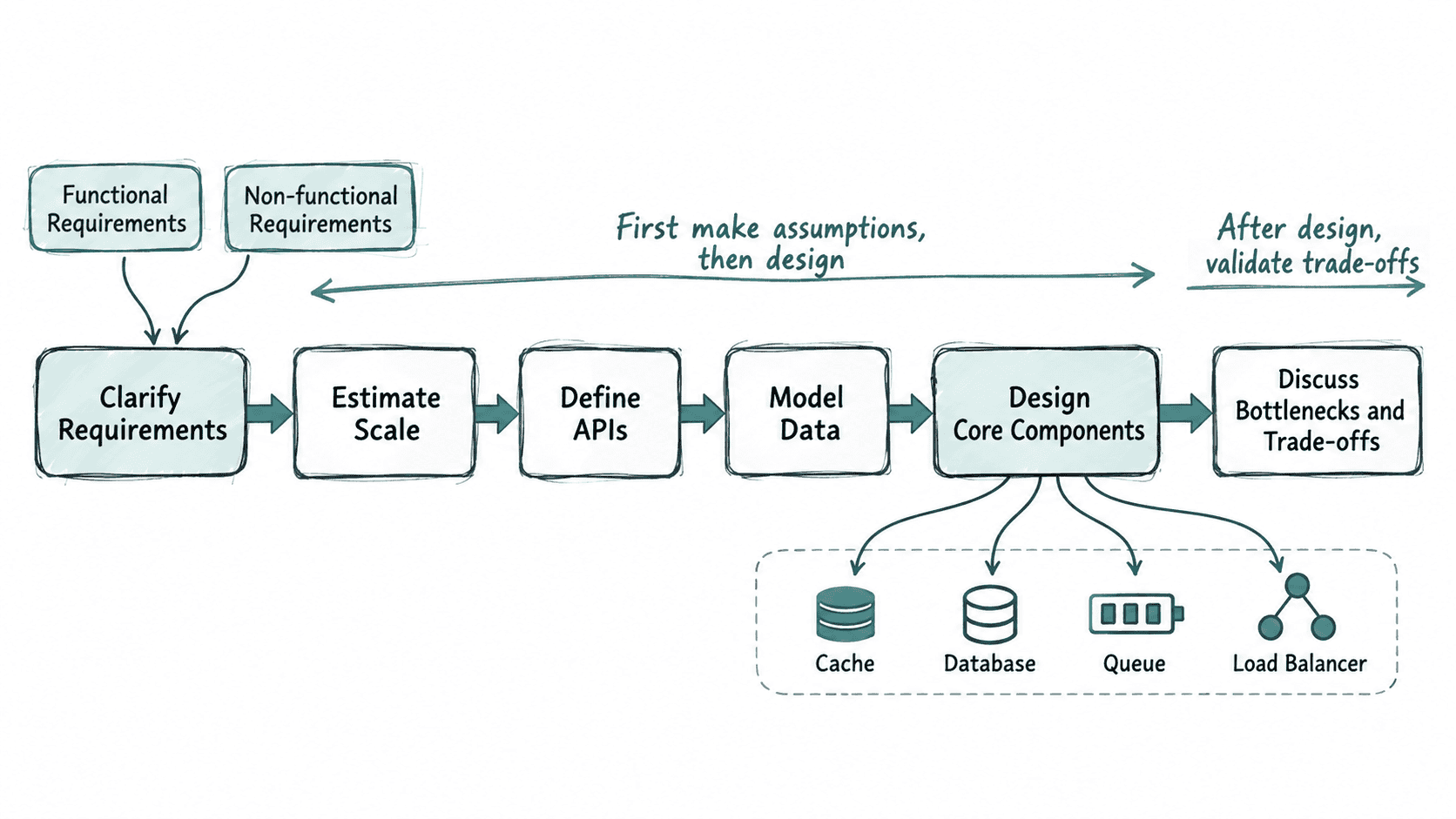
进入容量时,不需要为了展示数学能力做冗长计算。真正重要的是说明数字怎样影响设计。例如:With a read-heavy workload, caching popular mappings would reduce database traffic.
接口部分应保持简单,让后面的数据模型和组件设计都有明确对象:I would start with a create API and a redirect API. 如果题目继续追问,再补认证、限流或批量接口。
谈数据模型时,重点是实体、主键和主要访问模式,而不是枚举所有字段:The main lookup is from a short code to the original URL, so the short code should support efficient indexed access.
把组件说成因果链
只报组件名称很难证明你理解系统。比起说 We need Redis, Kafka and a database,更好的方式是先说明问题,再说明组件为什么出现。
例如设计短链接服务时,可以这样推进:The redirect path is latency-sensitive and read-heavy, so I would put a cache in front of the persistent store. On a cache miss, the service reads the mapping from the database and populates the cache.
这种表达有三个层次:业务要求是低延迟,负载特征是读多写少,因此引入缓存。即使面试官不同意具体技术选择,也能清楚看到你的推理路径。
描述组件之间的数据流时,可以使用稳定的连接句:The request first reaches...、The service then...、If that lookup fails...、Finally...。这些词比复杂长句更适合白板面试。
用权衡回答为什么
系统设计的高质量追问经常不是 What,而是 Why。此时不要把选择说成唯一正确方案,而要明确收益、成本和适用条件。
常用表达包括:
The advantage of this approach is..., but the trade-off is...I would choose A over B here because...This improves availability at the cost of...If the traffic pattern changes, I would reconsider this decision.
例如面试官问为什么不要求所有副本同步完成再返回,可以回答:For this use case, I would favor availability and low write latency over immediate consistency across every replica. The trade-off is that a recent update may not be visible everywhere immediately.
这里最重要的是边界清楚。不要为了显得高级而声称某个方案同时获得更低延迟、更高一致性、更低成本和更高可用性。
在追问中维护同一组假设
面试进入后半段后,面试官通常会修改条件,例如流量突然增长十倍、热点 key 出现、某一区域不可用。此时先指出哪个原假设发生了变化,再修改设计。
可以说:Earlier I assumed traffic was evenly distributed. If a small set of keys becomes extremely hot, that assumption no longer holds, so I would add protection specifically for hot keys.
如果需要推翻早先设计,也不用回避:Given this new requirement, I would change my earlier choice. 这种修正比强行维护旧答案更专业。
最后可以用几十秒收束方案:So the design uses stateless application servers, a cache for the read-heavy path, and persistent storage for the source of truth. The main trade-offs are cache freshness and database scalability. 系统设计回答的目标不是把所有技术都讲一遍,而是让面试官始终知道你当前的假设、决策以及为什么这样选。