
跨平台开发 / 系统课时
改造复杂商品接口模型
改造复杂商品接口模型
复杂商品接口往往把分页、价格、库存枚举和多态促销塞在同一份响应里。直接把原始 Map 传进页面会让类型判断散落各处。本节把契约拆成 Freezed DTO,用生成代码完成反序列化,再通过 Repository 隔离数据层,并用测试锁住关键字段和多态分支。
学习目标
- 能把嵌套商品响应拆成分页、商品、价格、库存与促销 DTO。
- 能使用 Freezed union 根据
type字段解析不同促销形态。 - 能把 DTO 接入 Repository,并用自动化测试验证分页、嵌套字段和多态契约。
先冻结原始接口契约
综合改造前先保留一份代表性响应。下面的 fixture 同时包含分页信息、嵌套价格、库存状态,以及两种促销类型;后续模型和测试都围绕这份契约设计。
{
  "page": 1,
  "pageSize": 20,
  "total": 2,
  "items": [
    {
      "id": "p-100",
      "name": "Keyboard",
      "price": {"amount": 299.0, "currency": "CNY"},
      "stock": {"status": "in_stock", "quantity": 8},
      "promotion": {"type": "discount", "percent": 10}
    },
    {
      "id": "p-200",
      "name": "Mouse",
      "price": {"amount": 129.0, "currency": "CNY"},
      "stock": {"status": "out_of_stock", "quantity": 0},
      "promotion": {"type": "coupon", "code": "SAVE20", "amount": 20.0}
    }
  ]
}
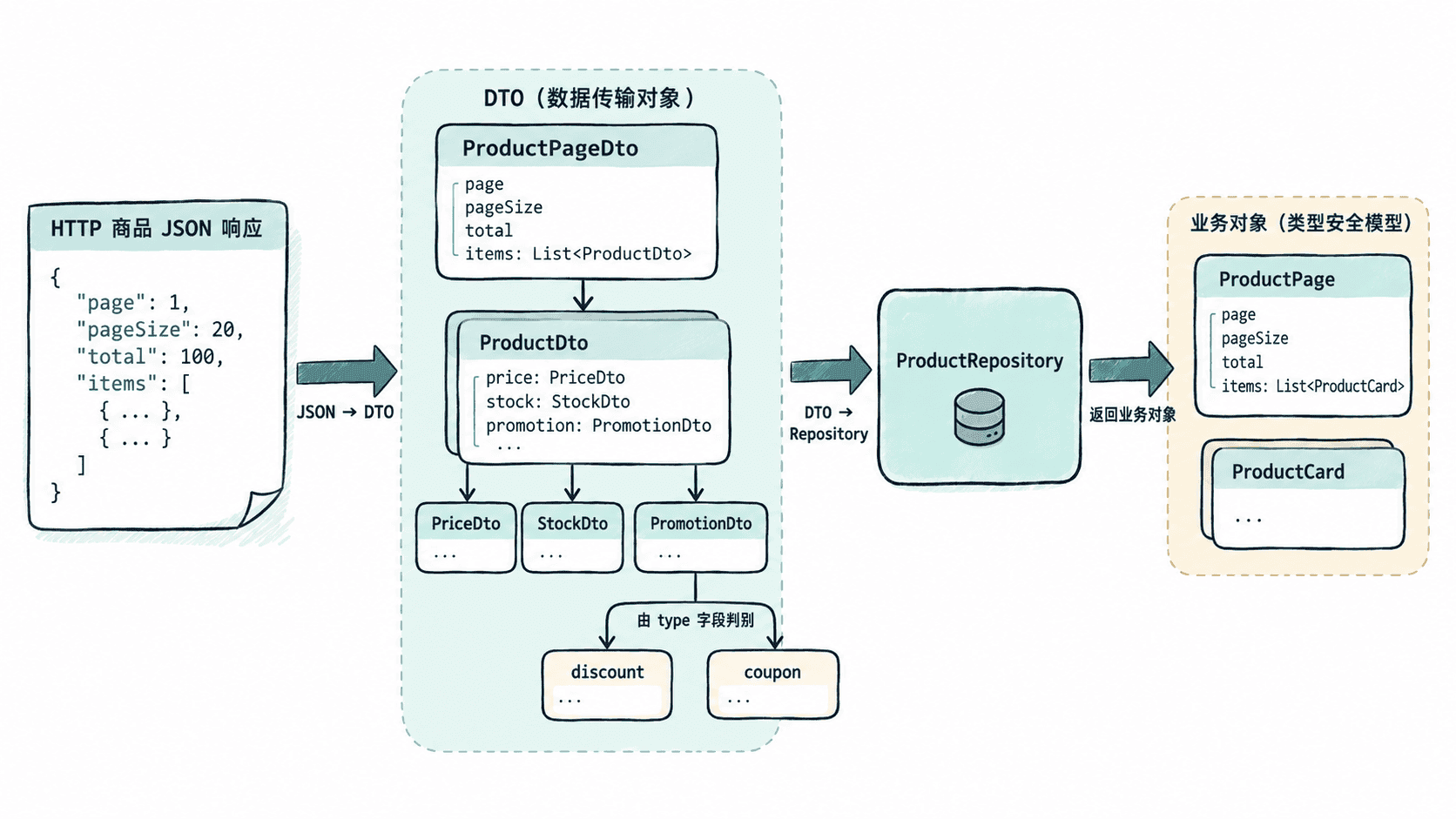
设计时把“传输结构”和“业务使用结构”分开:HTTP JSON 先进入 DTO,DTO 负责忠实表达接口;Repository 再把 DTO 转换成页面或领域层需要的对象。这样接口字段变化不会直接扩散到 UI。
用 Freezed 表达嵌套与多态
把以下文件放在 lib/data/product_models.dart。库存状态使用枚举约束固定值;促销使用 @Freezed(unionKey: 'type'),让生成代码根据接口里的 type 选择具体分支。
import 'package:freezed_annotation/freezed_annotation.dart';

part 'product_models.freezed.dart';
part 'product_models.g.dart';

@freezed
abstract class ProductPageDto with _$ProductPageDto {
  const factory ProductPageDto({
    required int page,
    required int pageSize,
    required int total,
    required List<ProductDto> items,
  }) = _ProductPageDto;

  factory ProductPageDto.fromJson(Map<String, dynamic> json) =>
      _$ProductPageDtoFromJson(json);
}

@freezed
abstract class ProductDto with _$ProductDto {
  const factory ProductDto({
    required String id,
    required String name,
    required PriceDto price,
    required StockDto stock,
    PromotionDto? promotion,
  }) = _ProductDto;

  factory ProductDto.fromJson(Map<String, dynamic> json) =>
      _$ProductDtoFromJson(json);
}

@freezed
abstract class PriceDto with _$PriceDto {
  const factory PriceDto({
    required double amount,
    required String currency,
  }) = _PriceDto;

  factory PriceDto.fromJson(Map<String, dynamic> json) =>
      _$PriceDtoFromJson(json);
}

enum StockStatus {
  @JsonValue('in_stock')
  inStock,

  @JsonValue('out_of_stock')
  outOfStock,
}

@freezed
abstract class StockDto with _$StockDto {
  const factory StockDto({
    required StockStatus status,
    required int quantity,
  }) = _StockDto;

  factory StockDto.fromJson(Map<String, dynamic> json) =>
      _$StockDtoFromJson(json);
}

@Freezed(unionKey: 'type')
sealed class PromotionDto with _$PromotionDto {
  const factory PromotionDto.discount({
    required int percent,
  }) = DiscountPromotionDto;

  const factory PromotionDto.coupon({
    required String code,
    required double amount,
  }) = CouponPromotionDto;

  factory PromotionDto.fromJson(Map<String, dynamic> json) =>
      _$PromotionDtoFromJson(json);
}
生成代码:
dart run build_runner build --delete-conflicting-outputs预期结果:
Exit code: 0
Generated: lib/data/product_models.freezed.dart
Generated: lib/data/product_models.g.dart
如果生成器报告冲突文件,不要手工修改 .freezed.dart 或 .g.dart;应先确认源模型和 part 文件名一致,再重新生成。
在 Repository 隔离传输模型
Repository 不应该把 DTO 原样泄漏给页面。下面是片段示例,依赖上一节的 product_models.dart 和真实的 ProductApi 实现;它把库存枚举和促销 union 转换为上层更容易消费的字段。
import 'product_models.dart';

abstract interface class ProductApi {
  Future<Map<String, dynamic>> fetchProducts();
}

class ProductCard {
  const ProductCard({
    required this.id,
    required this.name,
    required this.price,
    required this.inStock,
    required this.promotionLabel,
  });

  final String id;
  final String name;
  final double price;
  final bool inStock;
  final String? promotionLabel;
}

class ProductPage {
  const ProductPage({
    required this.page,
    required this.total,
    required this.items,
  });

  final int page;
  final int total;
  final List<ProductCard> items;
}

class ProductRepository {
  ProductRepository(this.api);

  final ProductApi api;

  Future<ProductPage> load() async {
    final json = await api.fetchProducts();
    final dto = ProductPageDto.fromJson(json);

    return ProductPage(
      page: dto.page,
      total: dto.total,
      items: dto.items.map((item) {
        return ProductCard(
          id: item.id,
          name: item.name,
          price: item.price.amount,
          inStock: item.stock.status == StockStatus.inStock,
          promotionLabel: _promotionLabel(item.promotion),
        );
      }).toList(growable: false),
    );
  }

  String? _promotionLabel(PromotionDto? promotion) {
    return switch (promotion) {
      DiscountPromotionDto(:final percent) => '$percent% off',
      CouponPromotionDto(:final code) => code,
      null => null,
    };
  }
}
这里使用 Dart 3 的模式匹配处理促销分支,避免在 Repository 中继续检查原始 type 字符串。接口如果新增第三种促销类型,模型层会先暴露变化,而不是让页面静默走到未知分支。
用测试锁住关键契约
下面的测试直接使用同一类响应结构,分别验证分页与嵌套价格、两个促销分支,以及 Repository 的最终映射。测试文件假设位于 test/product_repository_test.dart。
import 'package:flutter_test/flutter_test.dart';

import '../lib/data/product_models.dart';
import '../lib/data/product_repository.dart';

const fixture = <String, dynamic>{
  'page': 1,
  'pageSize': 20,
  'total': 2,
  'items': [
    {
      'id': 'p-100',
      'name': 'Keyboard',
      'price': {'amount': 299.0, 'currency': 'CNY'},
      'stock': {'status': 'in_stock', 'quantity': 8},
      'promotion': {'type': 'discount', 'percent': 10},
    },
    {
      'id': 'p-200',
      'name': 'Mouse',
      'price': {'amount': 129.0, 'currency': 'CNY'},
      'stock': {'status': 'out_of_stock', 'quantity': 0},
      'promotion': {
        'type': 'coupon',
        'code': 'SAVE20',
        'amount': 20.0,
      },
    },
  ],
};

class FakeProductApi implements ProductApi {
  @override
  Future<Map<String, dynamic>> fetchProducts() async => fixture;
}

void main() {
  test('parses pagination and nested price', () {
    final dto = ProductPageDto.fromJson(fixture);

    expect(dto.page, 1);
    expect(dto.total, 2);
    expect(dto.items.first.price.amount, 299.0);
  });

  test('selects discount and coupon variants', () {
    final dto = ProductPageDto.fromJson(fixture);

    expect(dto.items[0].promotion, isA<DiscountPromotionDto>());
    expect(dto.items[1].promotion, isA<CouponPromotionDto>());
  });

  test('repository maps the transport model', () async {
    final repository = ProductRepository(FakeProductApi());
    final page = await repository.load();

    expect(page.items[0].inStock, isTrue);
    expect(page.items[0].promotionLabel, '10% off');
    expect(page.items[1].promotionLabel, 'SAVE20');
  });
}
运行验证:
flutter test test/product_repository_test.dart -r expanded预期输出中的时间值可能不同:
<TIME> +1: parses pagination and nested price
<TIME> +2: selects discount and coupon variants
<TIME> +3: repository maps the transport model
<TIME> +3: All tests passed!
这组测试同时充当接口契约保护网。以后后端修改分页字段、库存枚举或促销 type 时,失败会集中在 DTO 解析或对应断言,而不是拖到页面渲染阶段才以空值或类型错误暴露。
控制兼容边界
综合模型改造完成后,仍要避免两个常见退化:一是为了“永远能解析”把大量字段改成 Object? 或 dynamic;二是在 Repository 里重新读取原始 Map,绕开已经建立的 DTO 约束。前者失去类型安全,后者让生成代码和测试失去价值。
合理的边界是:DTO 精确描述已知接口契约,少量历史差异由明确 converter 处理,多态结构由 union 建模;Repository 只做业务映射,不重新猜测 JSON。这样新增字段通常保持向后兼容,而字段改名、类型变化和未知促销分支会尽早失败并被测试发现。